
Surrey Superintendent Mark Pearmain on Global News June 10, 2026
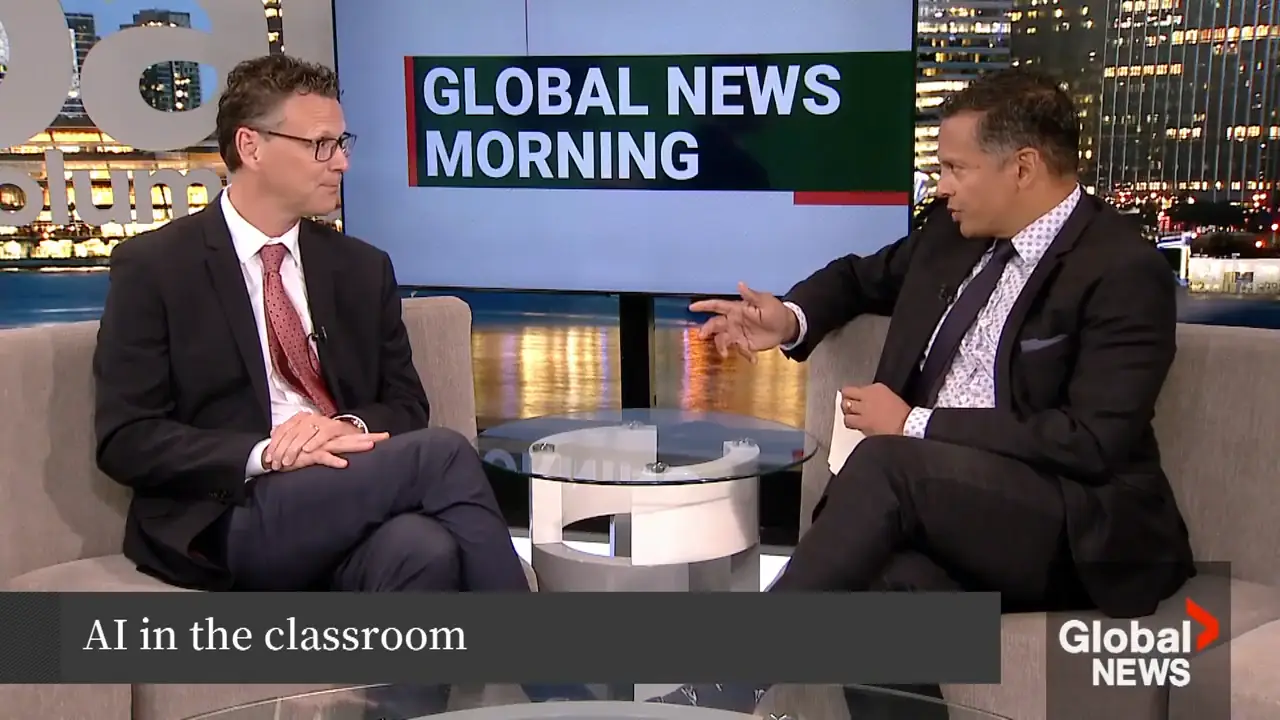
Mark Pearmain, Surrey School District Superintendent was on Global News as part of his recent media tour promoting AI usage in district classrooms.
It's worth watching or reading the transcript because it is a highlight-reel of how school administration are downplaying the risks of generative AI and ignoring the real concerns of parents.
As Global News did not feature the voices of parents or teachers, we have written our counter-points to each of Mark Pearmain's arguments along with the transcript.
Transcript
Jason Pires, Global News Morning BC:
Artificial intelligence has become part of our everyday lives, from streamlining work tasks to simplifying everyday routines. But when it comes to AI use in schools, opinion is still mixed on whether the technology should be embraced or avoided. Surrey Schools Superintendent Mark Pearmain joins us this morning among the speakers in an expert-led information session happening online this Thursday.
Mark Pearmain, Surrey School Superintendent:
Good morning.
Jason Pires:
Morning. Welcome back.
Mark Pearmain:
Thanks for having me.
Jason Pires:
Such a fascinating subject. First off, the difference between healthy AI and toxic AI. How would you describe that difference?
Mark Pearmain:
So we're really excited on Thursday night to be able to have this conversation with Dr. Shimi Kang, who is going to be explaining exactly what that is.
But a nutshell would be to take a think of healthy food, junk food, and toxic food.
That's the same concept that she's going to present.
A very easy way for parents to be able to kind of understand AI and then ultimately have conversations with their kids about what they're using, why they're using it, and what they should be aware of.
Jason Pires:
What's the biggest concerns you're hearing right now so far from parents and teachers?
Mark Pearmain:
Lots of questions, right? I think it's fair to say that there's lots of questions across the country about AI and what's it going to mean for job employment, what does it mean for learning.
All of those are valid questions, which is really why in Surrey we want to have those conversations publicly, open up dialogue so that parents understand what we're thinking, what we're doing, and ensuring that they have voice to be able to ask their questions and we can answer them to the best of our abilities.
Our comments:
Mark Pearmain skillfully rephrases parents' concerns into parents' "questions", as if they do not have concerns.
Parents and teachers do have legitimate concerns about how these AI products will affect their childrens' education.
- Will students learn less?
- What about mental health effects like psychosis?
- Will students become reliant on AI products to think?
- Are there any benefits to these products?
Jason Pires:
So what is Surrey doing early on? There's no instruction manual, there's no model to follow.
Our comments:
There may not be an "instruction manual" but there are scientific studies that have been done on the effects of chatbots on students.
They show that students remember less, understand less at a time where they need to learn how to construct arguments and think for themselves.
Jason Pires:
Where are we compared to the rest of North America in terms of education and AI?
Our comments:
Mark Pearmain does not give any information about what is happening with regards to AI in North America. So we will.
In New York City, the a majority of city council members are asking for a pause on AI in schools. This is spurred by a petition from parents an educators that has 4000 signatures.
Nearly 1000 people have signed a petition calling for a pause on AI in British Columbia.
Parents in LA are asking for iPads and laptops to be removed from classrooms.
Mark Pearmain:
So what we're doing in Surrey is that we're really taking an approach which focuses in on privacy of security of students and then ultimately wanting them to understand how to use platforms safely. We have six platforms that we have approved.
They've gone through PIAs, so Privacy Impact Assessments, that we use and they're under the use of teachers so that when kids use them they're actually utilizing them in a classroom environment, usually through a QR code, so the kids aren't putting their personal data in, and they get to the experience of actually using these AI platforms.
Our comments:
Mark Pearmain focuses the conversation on privacy. This is a legitimate concerns, but he does not mention other concerns that parents have.
Like AI products that tell children how to commit suicide.
Or how chatbots can lead to delusions and psychosis.
Mark Pearmain:
We also are taking the approach of, you know, really hammering home.
Don't put in your private security data, don't put in personal information, because we know kids are using ChatGPT or Claude or Gemini or whatever it is outside of the classroom.
So for them it's a matter of understanding what the pitfalls are and ensuring that if they're using it, they're using it in a safe way.
Our comments:
Again, focusing on the thin area of privacy moves the conversation away from the real harms that chatbots can cause.
Jason Pires:
What's the grade level are we talking about? Because I know people are surprised to hear, I think when you were here last time, it starts quite early.
Mark Pearmain:
Well you want to talk about safety early, because let's be honest, when a student or a child picks up their parent's phone, even if they're pre-school, they're already actually utilizing AI.
They just don't know it.
Our comments:
This is an insultingly bad-faith argument.
It is unclear what "AI" Mark Pearmain is referring to. Phones can have "AI"-enabled search apps, camera apps that use "AI" to invent details to up-scale photos, and a host of other applications.
Generative AI chatbots being put into classrooms is clearly not the same as an app being available on a parent's phone.
This kind of "gotcha" is trying to tell parents, teachers and students that because their phone might contain a product labelled "AI", they cannot criticise classroom chatbots that have negative effects on learning and mental health
Mark Pearmain:
So you start with the safety conversations and the awareness as early as you can. We certainly are seeing classrooms grade five, six, seven using it.
That's totally under teacher supervision.
Our comments:
In Surrey students as young as 10 are using AI. Even younger than VSB's 13+ rollout.
The issue is not whether it is under teacher supervision, the issue is that it does not aid learning and in fact harms it.
Mark Pearmain:
And then high school students are using it both outside of the classrooms and possibly with classroom environment, classroom supervision as well.
Our comments:
Again, completely unaddressed is that these products harm retention, harm learning and are addictive.
Jason Pires:
Are teachers in Surrey right now using part of their course curriculum as specific as "Go to AI and research this"?
Mark Pearmain:
They could be.
AI is really following under the digital literacy concept of our curriculum.
So we expect our students to be digitally literate when they graduate.
And that's inclusive of all digital literacies that are out there, all platforms, including AI.
So this is just an extension of the curriculum.
Our comments:
When parents think of "digital literacy" they think of students learning how to use multiple sources to fact-check anything online.
Similarly, teaching students about generative AI, chatbots and their risks should be part of a digital literacy curriculum.
Both of these would not take very long to teach.
However them in a few hours is not the same as making chatbots available in every class.
Surrey Schools have 6 different AI products available. The superintendent speaks about AI as a "genie".
Mark Pearmain:
And they could be using it outside to do research, but you could also be having classroom teachers, for example, putting a math calculation into an AI and then using it to show students if it's correct, to break it down into easier ways to understand it, or actually for the students to see what's the bias that's coming out of it and to be able to challenge it.
Our comments:
This gets to the fundamental problem with the "critical thinking" discourse surrounding generative AI and chatbots.
Mathematical problems have a definite, correct answer that can be verified. The risk that comes with chatbots and generative AI is when you ask it questions you don't know the answer to.
Students are in school to learn and do so by asking questions where they do not know the answer.
School administrators like Mark Pearmain admit that generative AI often output incorrect answers, so they say "we want students to fact-check what the AI says".
If you want students to fact-check everything output by the chatbot, then what is the point of using the chatbot?
It does not save time, it only offloads thinking that should be done by the student.
Jason Pires:
Briefly, does AI potentially diminish critical thinking in your mind?
Our comments:
The host leaves this point to last, and reduces its seriousness by prefacing it with "briefly", as if it's barely worth mentioning.
Mark Pearmain:
I actually think it's going to augment it, because one of the things that we really need to focus on is critical thinking cross-analysis to understand if what you're getting from AI is actually true or not.
Our comments:
As we mention above, "critical thinking" is always mentioned by school boards when promoting AI.
If students are supposed to fact-check everything output by the chatbot, then what is the point of the chatbot?
Why is a product that lies convincingly being put into classrooms?
Mark Pearmain:
And so these are skills, ultimately, that our kids need to be just refined and really, really reinforced of how to use.
Ultimately, for us, we recognize that AI is here.
So we can't put the genie back in the bottle.
Our comments:
AI is often framed by its proponents as being "inevitable". That is somehow used by people in education to mean that AI in classrooms as similarly "inevitable".
This framing of inevitability has a number of effects:
- It diffuses opposition from parents, teachers and students. If something is inevitable, then it is pointless to resist it.
- It removes responsibility from schoolboards and superintendents. It frames them as simply following something that cannot be changed, rather than the reality which is that they are making an active choice to put it into classrooms.
Mark Pearmain used the same "cannot put the genie back in the bottle" line on CBC.
Mark Pearmain:
So now we want to make sure that we prepare our kids, that they have future-ready skills, they know how to collaborate, they know how to be critical thinkers, they know how to analyze, and they know how to cross-reference what they're reading.
Our comments:
In the past, schools taught students fundamental skills. As new technologies emerged, they were able to use those skills and succeed.
Despite not being taught how to use Microsoft Excel in school, we somehow learned how to do it in the workplace.
Fundamentally redesigning the education system to work with a technology that did not exist 3 years ago, will not help students when they graduate in 5 years' time and the technology has already changed.
They need to learn how to think for themselves, without the aid of products like Copilot and Gemini.
Jason Pires:
The online event, Thursday at 6:30, not open just to families of Surrey, open to anyone?
Mark Pearmain:
Open to everybody. We want you to attend.
This is a really important conversation.
But also, just frankly, the Prime Minister came out about AI literacy.
Here's a great opportunity for all to learn.
Jason Pires:
Thanks, Mark.
Mark Pearmain:
Thanks for having me.
Final remarks
We as parents, guardians, teachers and students, have the power to resist anything that harms students' education.
AI is not inevitable.
Our comments:
The event that they mention is titled "Junk, Toxic & Healthy AI: Helping Families Understand the Difference".
Talking about AI as food is an interesting choice. Everyone needs food to live, it's just a case of choosing the right food. So of course everyone needs to use AI, it's just a case of using the right AI.
The idea of not using AI is not mentioned.
The host of the event is Dr. Shimi Kang, an AI advocate.